Sustainability
At Eminence Organic Skin Care, we’re deeply thankful for what nature provides. Fruits, seeds, herbs and flowers all support our health, our diets and our skin. We use effective botanicals in every product and have seen the benefits of organic ingredients firsthand. That’s why we believe in giving back to the planet. In 2012, Eminence Organics launched Forests for the Future™.
Through this program we plant a tree for every product sold. We also train farmers and support environmental restoration projects in the rural communities where trees are planted. Our partner, Trees for the Future, is a nonprofit that helps improve the lives of low-income farmers by teaching agroforestry and sustainable land use while organizing the hands-on work to make this possible.
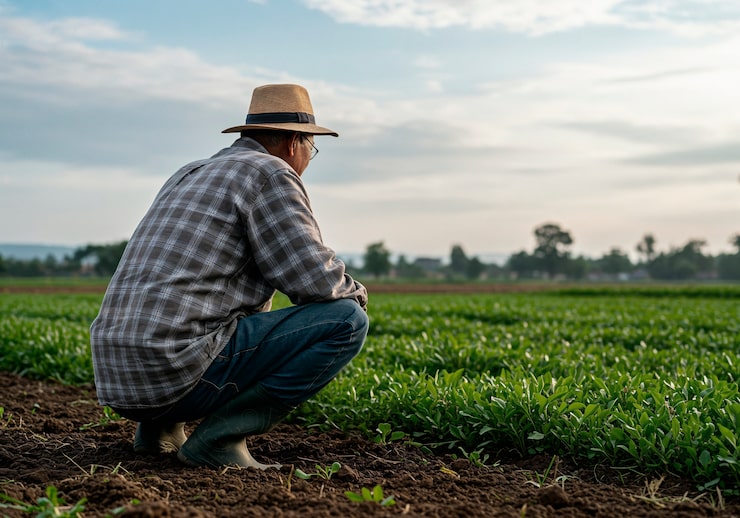
Meet David Abach, a Kenyan farmer who shared how his farm has changed since joining the program, and learn more about the real impact Eminence Organics and Trees for the Future are making.
David’s Story
David joined the Trees for the Future Forest Garden Training Program, supported by Eminence, in 2020. He realized about half a hectare of his land could be turned into a Forest Garden.
Over the past decade, Trees for the Future has promoted the Forest Garden method. This approach uses sustainable farming ideas to recreate a forest-like ecosystem on farmland. Forest Gardens include a mix of trees, shrubs, fruits, vegetables and herbs placed to support each other, help restore the soil and bring back nutrients.
Through the training, David quickly learned sustainable agroforestry techniques that would benefit his land.
A Better Farm
Farms with Forest Gardens grow a wide range of healthy crops, giving farmers more nutritious food, higher biodiversity and better incomes while restoring soil and storing carbon. David explains that his farm is much improved. Before, he grew only maize and beans. Now he also has Cajanus trees and vegetables that provide food.
David uses several agroforestry methods in his Forest Garden. One is alley cropping—planting rows of trees or shrubs that form lanes for growing multiple crops in the same space. He plants Cajanus (pigeon peas) in these rows to add nutrients to the soil. These plants act like a living fence around the garden, enriching the soil, offering animal fodder and serving as a windbreak. Without the trees, strong winds could knock down his crops and harm his livelihood.
Thousands of Trees
In just three years, David increased the number of trees on that part of his farm from 12 to more than 3,300. Though many are still maturing, they are already creating a helpful microclimate on his land.
The trees have made his crops less vulnerable to Kenya’s dry conditions. During the dry season, the climate inside the Forest Garden is different—less harsh—so crops don’t dry out as much as they would on bare land.
Joining the Carbon Market
By taking part in the Trees for the Future program, David can also access the carbon market. The carbon market allows organizations to buy carbon credits from projects that absorb or reduce greenhouse gases. This provides funding for environmental work and lets companies offset their emissions. The trees on David’s farm can earn him extra income through carbon credit sales, since Forest Garden farmers in Kenya can participate in this market.
Better Soil
Outside the Forest Garden, David still grows maize and beans using traditional methods, and the difference is clear.
He notices the soil quality is much better where vegetables grow alongside Cajanus than where maize grows alone. The maize outside the garden looks yellow and nutrient-poor, while the crops inside the Forest Garden benefit from compost and the nitrogen added by the Cajanus trees, producing stronger, healthier harvests that David can sell or use to feed his family.
A Promising Future
From growing food to helping fight climate change, David is using his Forest Garden—made possible by these initiatives—to build a better life for himself and his 13-person household.
Before, he had to spend money to buy vegetables. Now he gets vegetables from his Forest Garden and can use the money he would have spent on them for fish, meat and school supplies for his children.
Since joining the Trees for the Future Forest Garden Training Program, supported in part by Eminence Organic Skin Care, David has accessed the training and resources that made these changes possible. We’re proud to have played a role in helping him secure food and income for a more stable future.
Read more about David’s story here.